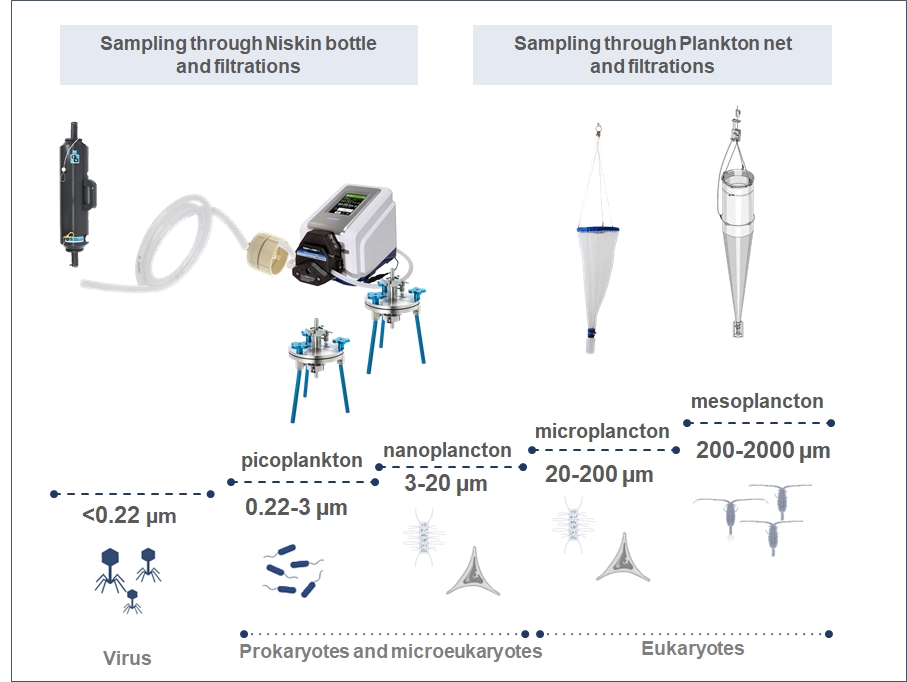
To ensure sampling consistency and comparability of results, significant effort has been devoted to the development of Standardized Operating Procedures (SOPs), which define the workflows for omics analysis of marine samples, including sample collection, preservation, nucleic acid extraction, and analytical procedures.
Sample collection and processing occurred monthly, adhering to the protocols implemented by the Italian Long-Term Omic Observatory for Marine Biodiversity (NBFC — Spoke 2 — Activity 5).
Surface seawater samples were collected using Niskin bottles, pre-filtered through a 200μm mesh, and subsequently subjected to size-fractionated filtration (20μm→3μm→0.2μm). Subsurface or bottom samples were also collected at the Portofino Promontory, the Gulf of Trieste, and the Marechiara site in the Gulf of Naples.
For the collection of microplancton, a 20μm mesh plankton net was towed horizontally at the surface for approximately 3-5 minutes. The 20μm→200μm size fraction was collected by sieving out any organisms larger than 200μm. Similarly, for the collection of mesoplancton, the 200μm→2000μm size fraction was sampled using a WP2 plankton net (Ø57cm; 200μm mesh size) towed vertically from the maximum local depth to the surface. This sample was then sieved through a 2000μm metal sieve.
The net samples were subsequently diluted to a final volume of 1L, split into 250mL aliquots, and filtered onto 10μm PC (Polycarbonate) filters for omics analyses.