
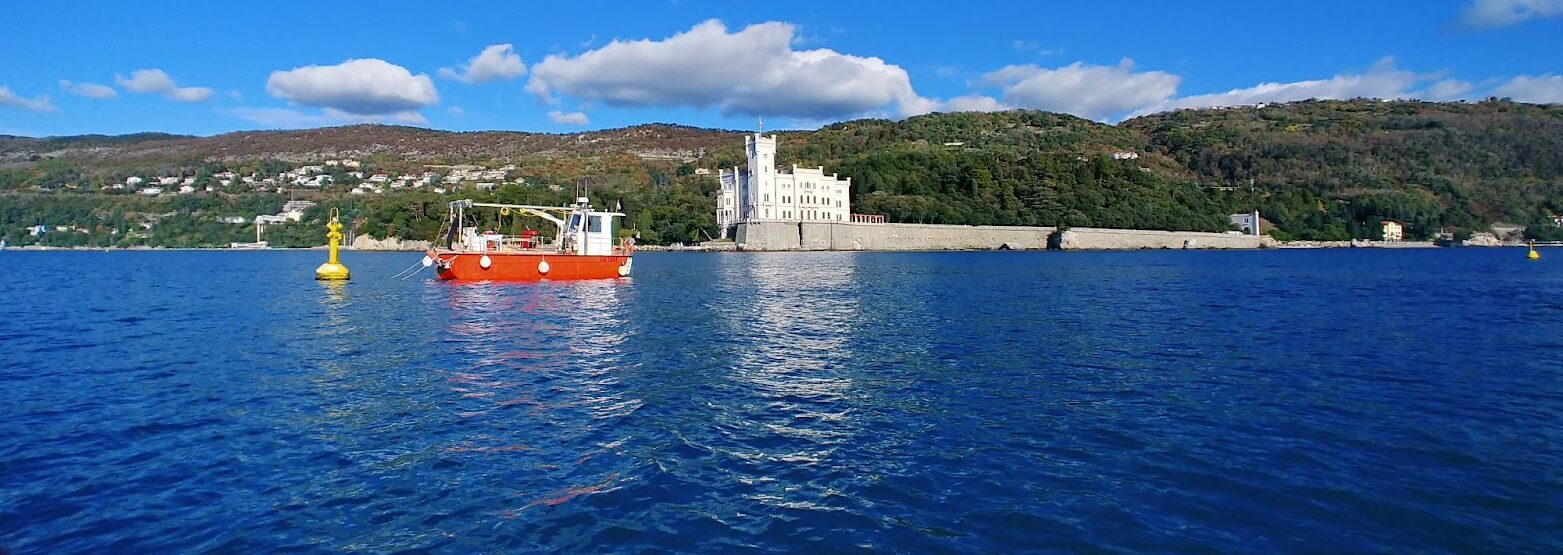
Site description
The Gulf of Trieste is a shallow (<25 m; 500 Km2), river-influenced embayment located in the northernmost sector of the Adriatic Sea. The main freshwater inputs come from the Isonzo and the Timavo rivers in the northern area, while torrential freshwater sources are scattered along its eastern boundary. The area is under the influence of a strong wind regime, characterised by the alternance of south- and north-easterly winds (i.e., Scirocco and Bora, respectively). Atmospheric processes, river discharge and water mass dynamics come together in large oscillations of salinity (29–38.5) and temperature (4–29.2°C), with strong summer stratification and homogeneous water column mixing during winter. The ensemble of these forcings translates into wide, yet recurrent, biogeochemical fluctuations. The sampling station (45°42′2.99″ N; 13°42′36.00″ E) lies at the edge of the Miramare Marine Protected Area, ~200m offshore, with a bottom depth of ~17m. This site (https://deims.org/96969205-cfdf-41d8-979f-ff881ea8dc8b) has been included in the LTER network since 2006.

Omics activities at the site
Sampling activities have been carried out at the LTER site Gulf of Trieste since the 1970s, targeting plankton dynamics within the peculiar biogeochemical context of the northern Adriatic Sea. Since January 2024, monthly sampling has been carried out following Standardized Operating Procedures (SOPs) implemented within the Italian Omics Observatory Network for Marine Biodiversity (NBFC — Spoke 2 — Activity 5).
Besides the activities within the Italian Long-Term Omic Observatory for Marine Biodiversity, omics approaches (i.e., DNA metabarcoding, metagenomics and metatranscriptomics) targeting prokaryotes, protists, and mesozooplankton have been integrated into routine sampling in the Gulf of Trieste since the late 2010s.
